Society ·
Crypto is already in Brazilians' pockets, and not just among the elite
The 2nd National Cryptocurrency Survey, by Paradigma and Datafolha, shows 29 million Brazilians who have owned crypto, most of them earning up to three minimum wages.
By Redação Esquerda Cripto · 7 min read

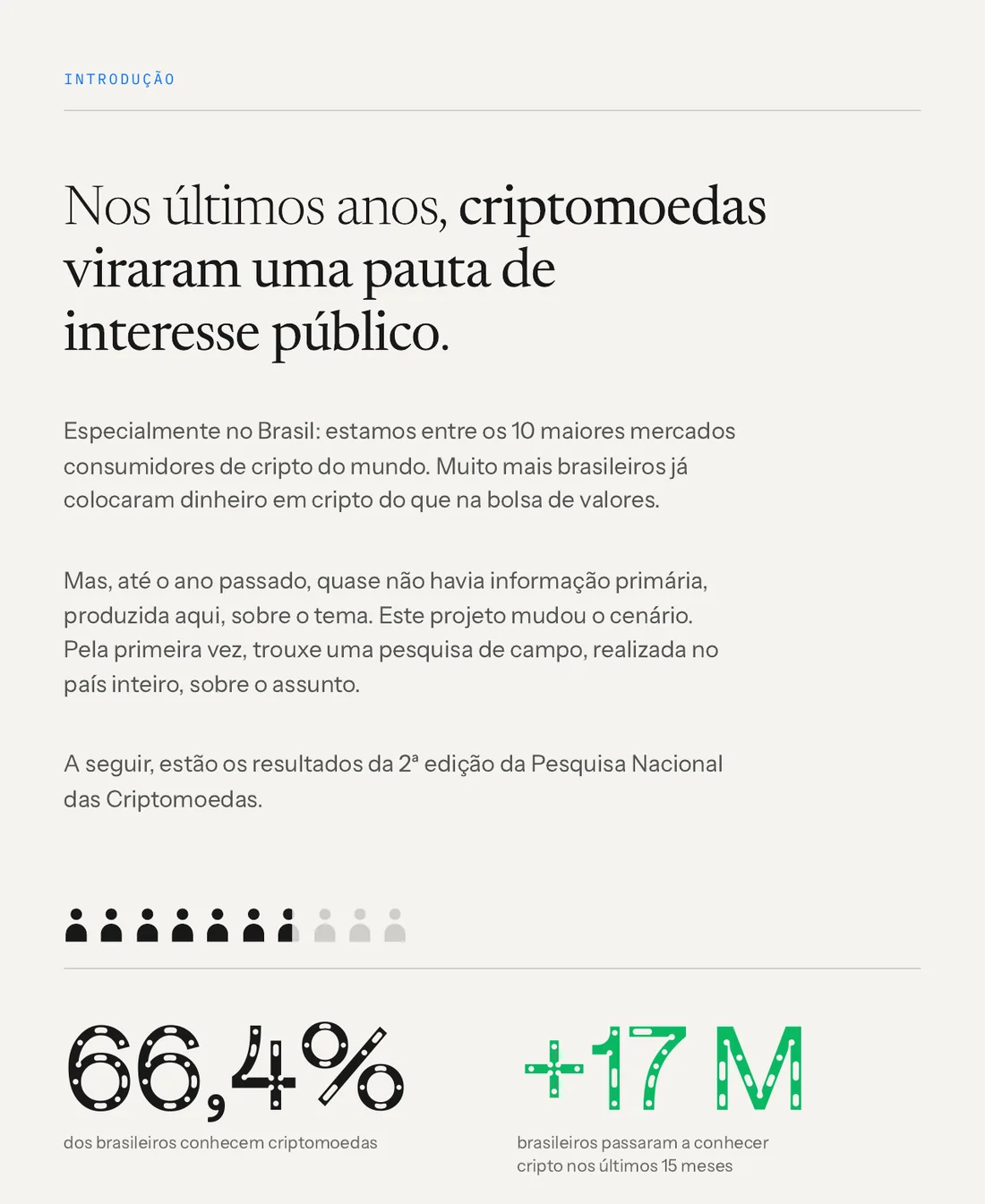
Two in three Brazilians have heard of cryptocurrencies. And 17.2% of the population, about 29 million people, have put money into them. The figures come from the 2nd National Cryptocurrency Survey (Pesquisa Nacional das Criptomoedas), carried out by Paradigma, Brazil's first research firm specializing in crypto, in partnership with Datafolha, and released in August 2026.
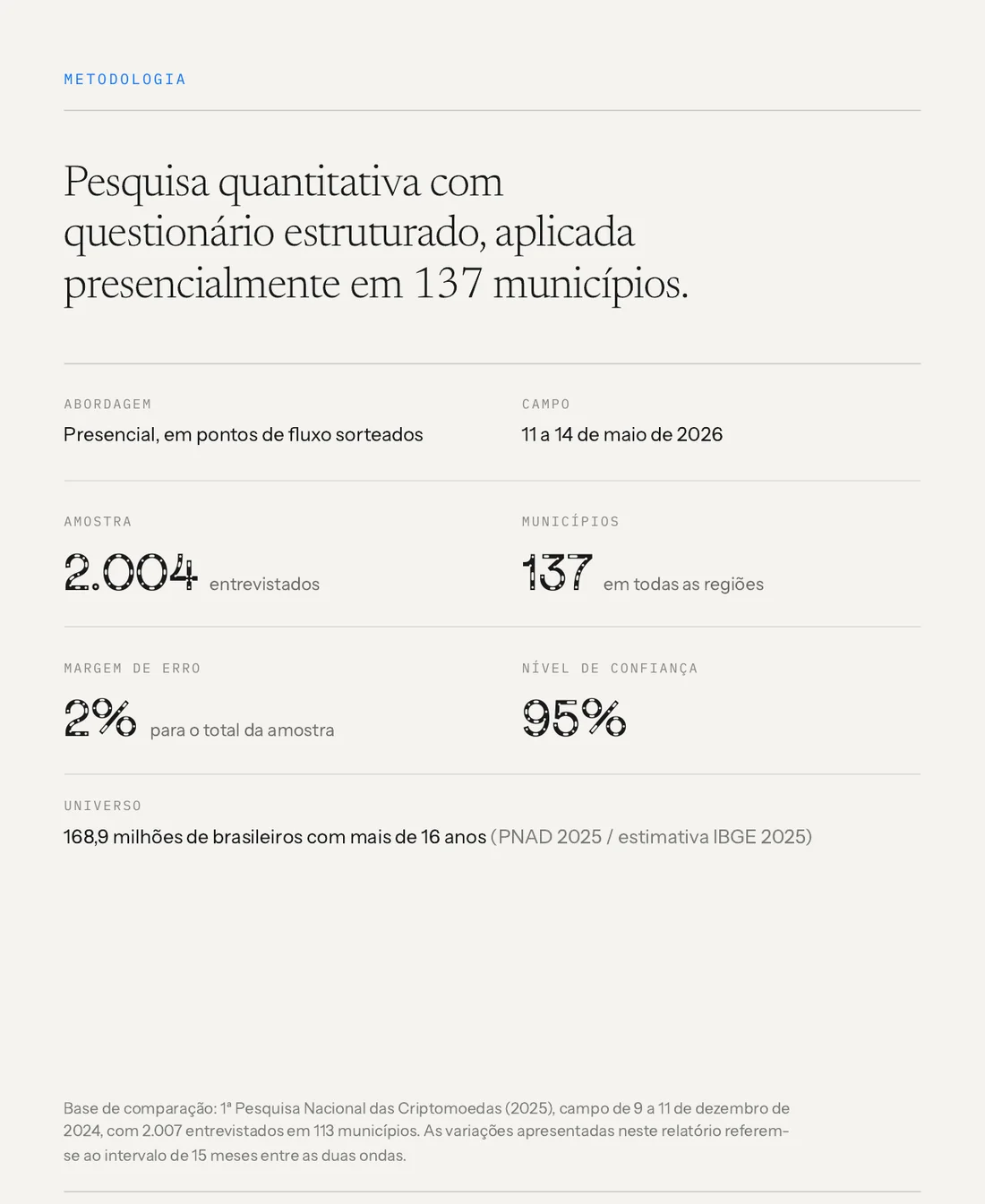
The survey interviewed 2,004 people aged 16 and over, in person, in 137 municipalities across every region, between May 11 and 14, 2026. The margin of error is 2 percentage points, with a 95% confidence level. The first edition was conducted in December 2024, with 2,007 interviews in 113 municipalities, which makes it possible to compare changes over 15 months.
The study was sponsored by Coinbase and Hashdex, companies in the sector, and supported by ABcripto, the association that represents the market. That is relevant context for readers, even though data collection was carried out by one of Brazil's most established polling institutes.
Awareness has grown, and Bitcoin leads
According to the survey, 66.4% of Brazilians know about cryptocurrencies, up 10.1 percentage points from the previous edition. In 15 months, more than 17 million people became aware of the topic.
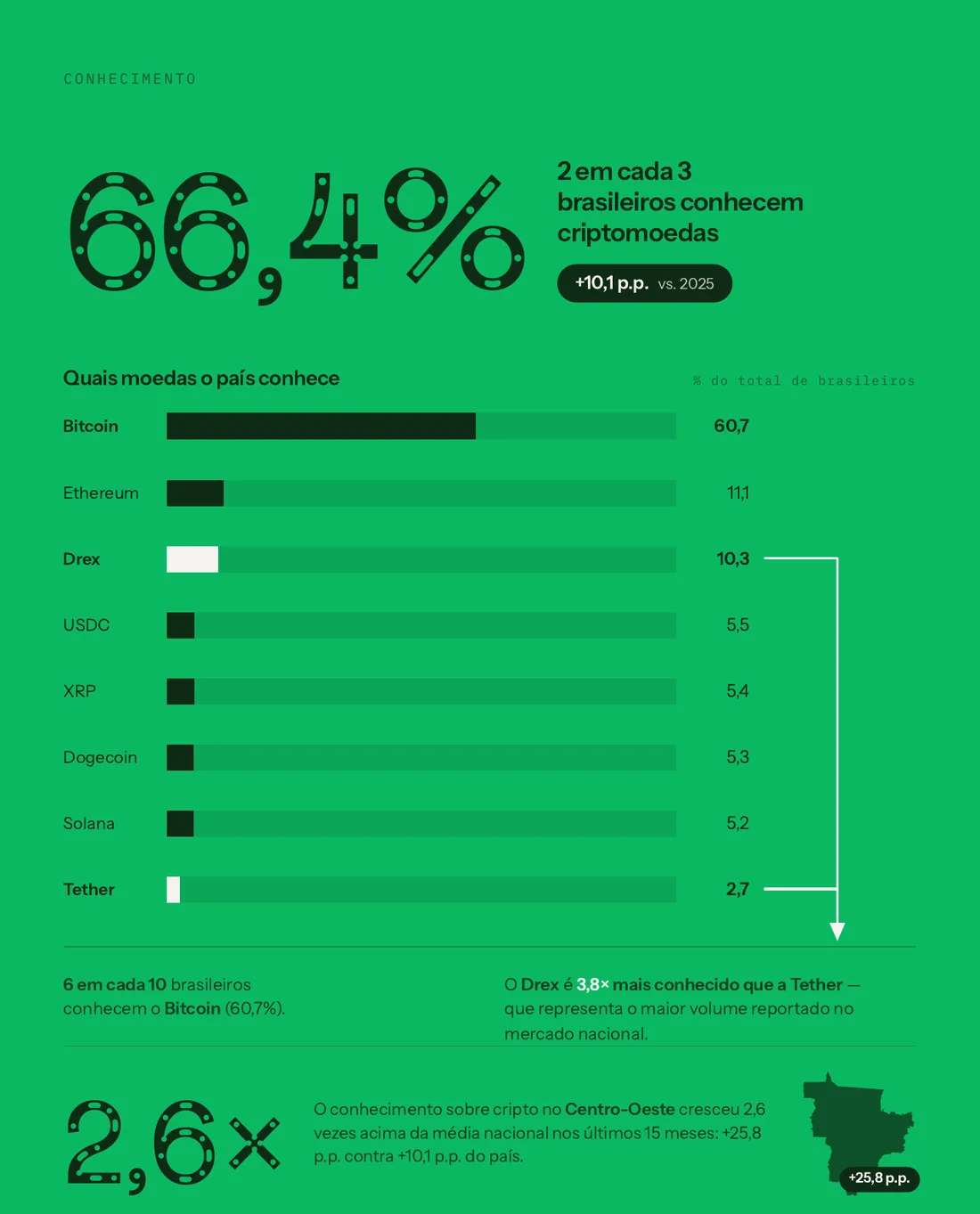
Bitcoin is by far the best-known coin: six in ten Brazilians (60.7%) know what it is. Next come Ethereum (11.1%) and Drex (10.3%), the Central Bank's digital currency platform. Tether, the stablecoin with the largest trading volume in the Brazilian market, is known by only 2.7%.
More popular than the stock market
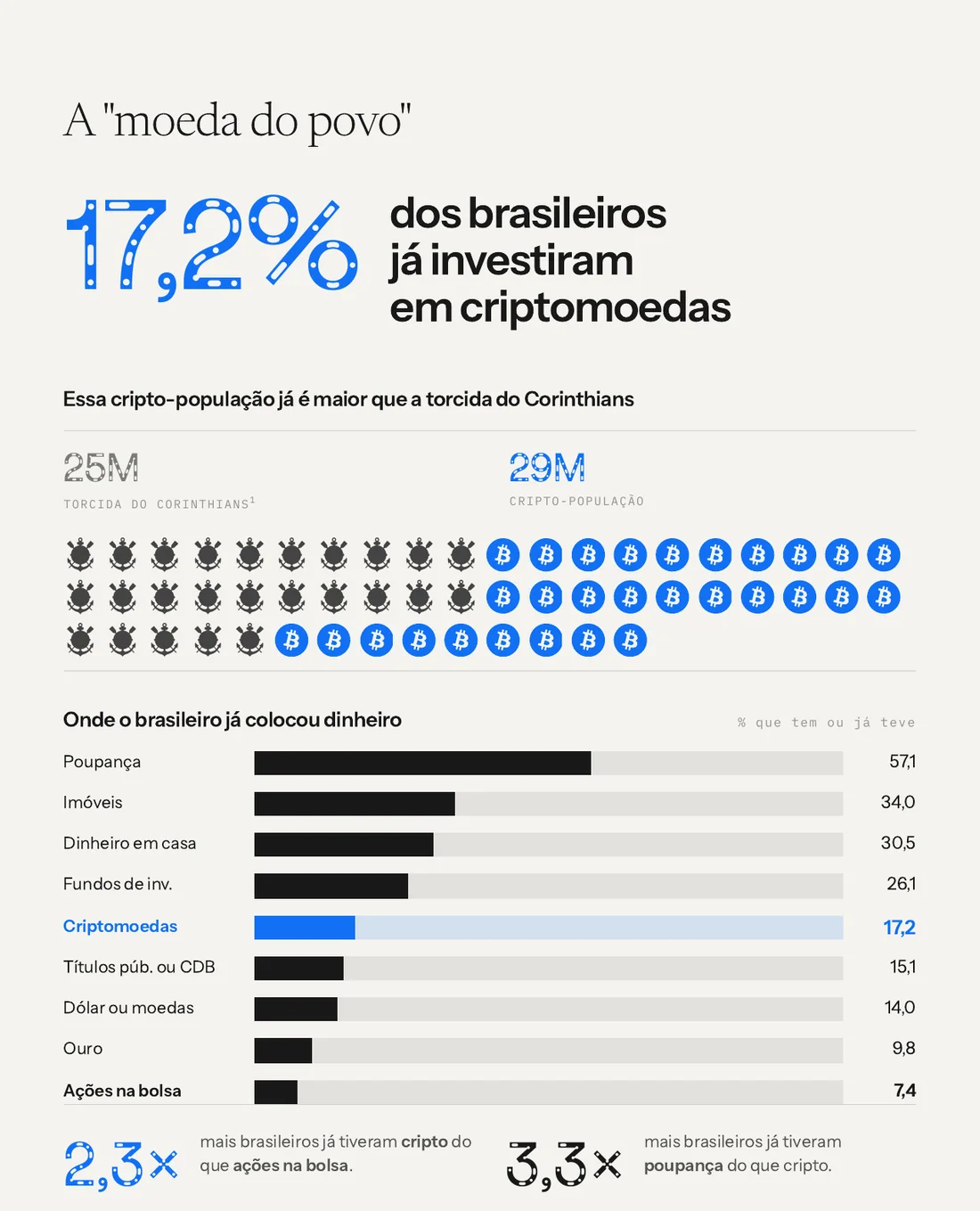
The 17.2% who have invested in crypto make up what the authors call the crypto population. The group already outnumbers the fan base of Corinthians, one of Brazil's biggest football clubs, estimated at 25 million people by Ipsos-Ipec.
Among ways of saving money, crypto ranks fifth, behind savings accounts (57.1%), real estate (34.0%), cash at home (30.5%) and investment funds (26.1%). It is ahead of government bonds and bank CDs (15.1%), dollars (14.0%), gold (9.8%) and stocks (7.4%). In practice, 2.3 times more Brazilians have owned crypto than stocks.
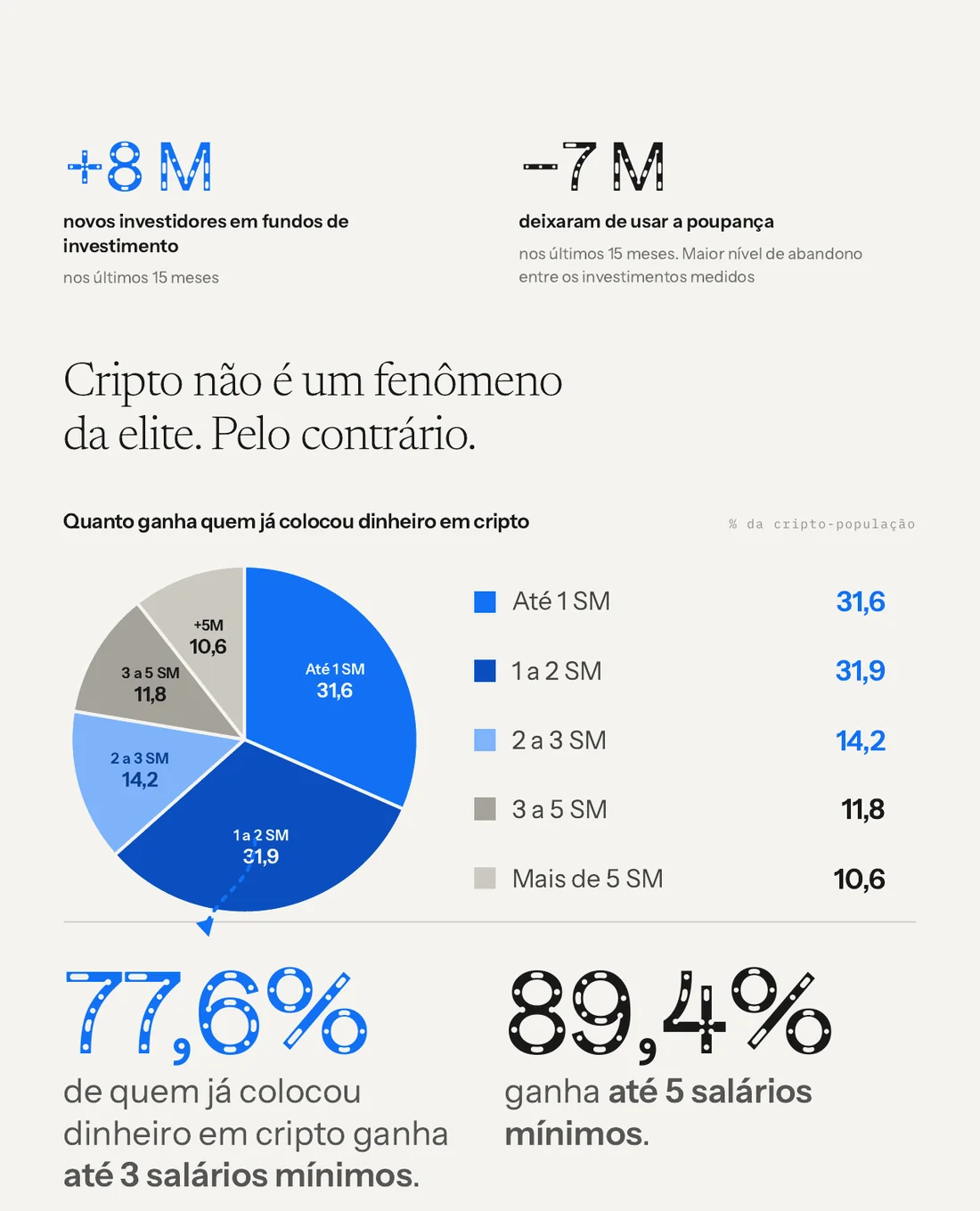
The survey also records a shift in habits: 8 million people started investing in funds over the last 15 months, while 7 million left traditional savings accounts, the largest drop among the investments measured.
A popular phenomenon
The most striking finding breaks a stereotype. Among those who have put money into crypto, 31.6% earn up to one minimum wage and 31.9% earn between one and two. Including those who earn up to three minimum wages, they make up 77.6% of the crypto population. Only 10.6% earn more than five minimum wages.
For the authors, crypto is not an elite phenomenon. For a movement concerned with financial inclusion, this finding carries a responsibility: if it is the bottom of the pyramid that is entering this market, it is precisely these people who most need information, protection against scams and clear rules.
Crypto and politics
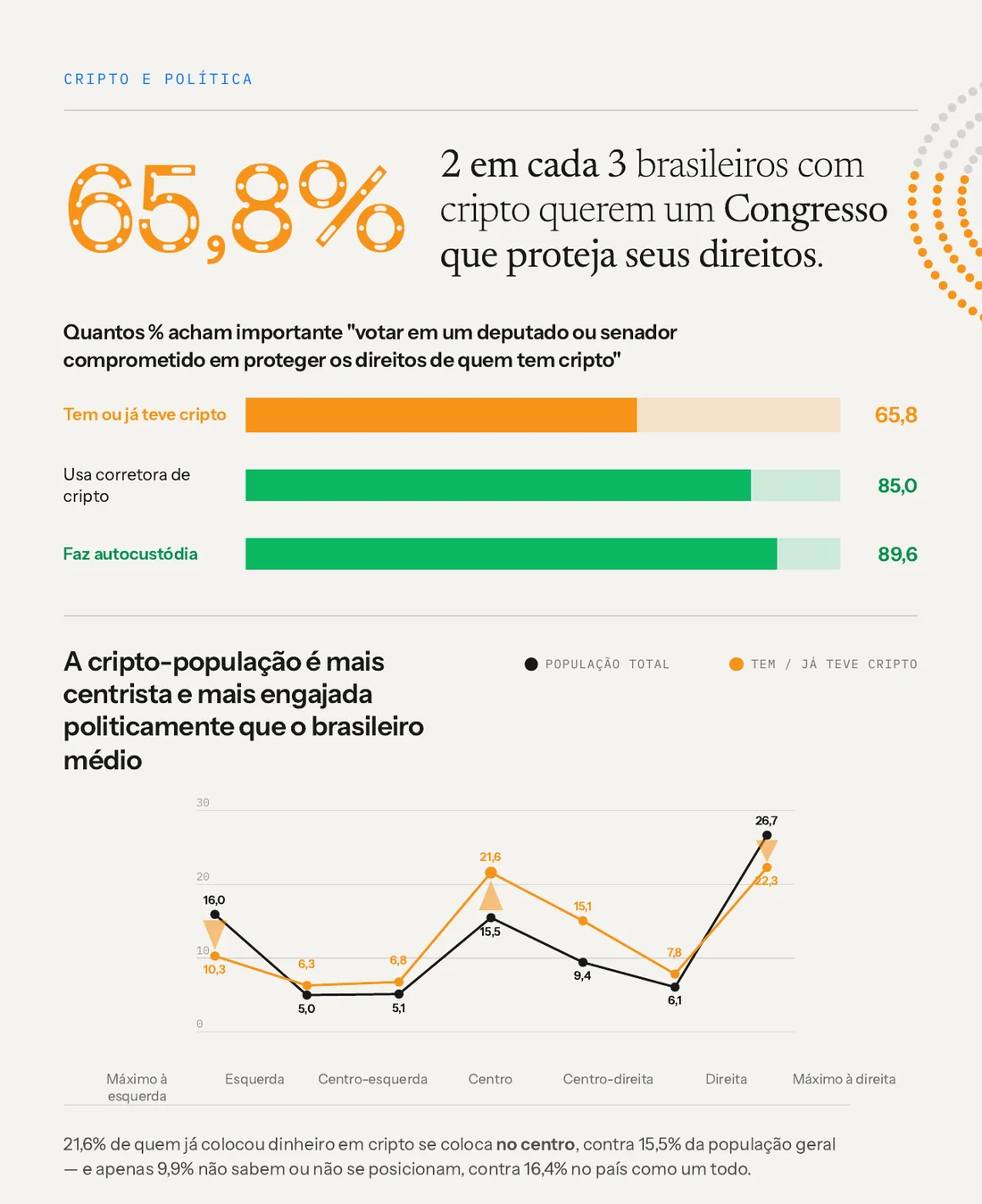
The survey also measured how the topic relates to voting. Among those who have or have had crypto, 65.8% consider it important to vote for a congressperson or senator committed to protecting the rights of crypto holders. The figure rises to 85.0% among exchange users and 89.6% among those who self-custody, that is, who hold their own keys.
On the political spectrum, the crypto population is more centrist than average: 21.6% place themselves at the center, against 15.5% of the general population. There are fewer people at the extremes, both at the far left (10.3% against 16.0%) and the far right (22.3% against 26.7%). And only 9.9% do not know or do not take a position, against 16.4% nationwide.
These figures reinforce a thesis Leftist Crypto defends: the topic does not belong to a single political camp, and those who stay out of the debate stop speaking to millions of voters.
Banks have become the gateway
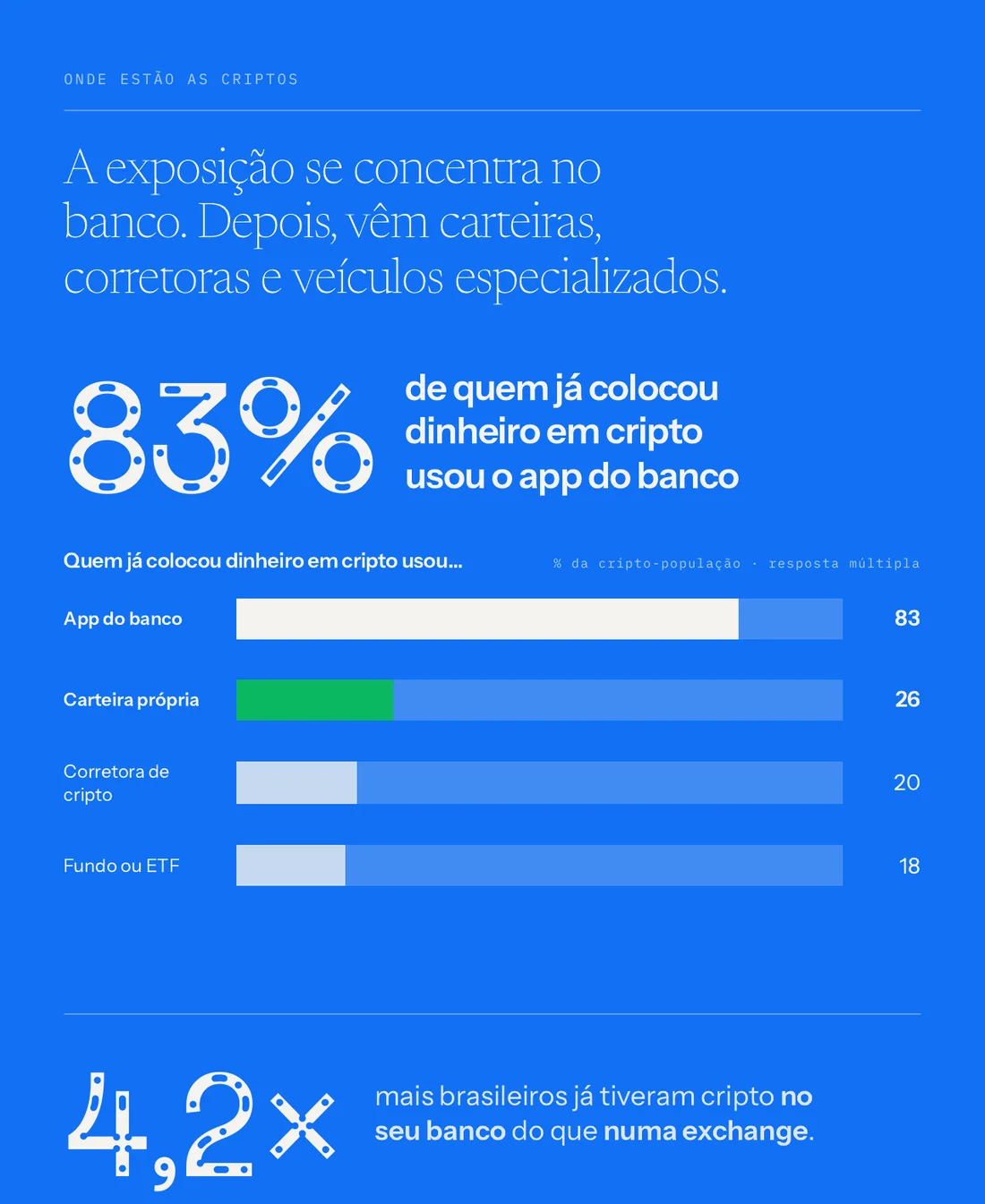
Crypto exposure is concentrated in banks. Among those who have invested, 83% used their own bank's app. Next come self-custody wallets (26%), specialized exchanges (20%) and funds or ETFs (18%). According to the survey, 4.2 times more Brazilians have held crypto at their bank than on an exchange.
Gender and education gaps
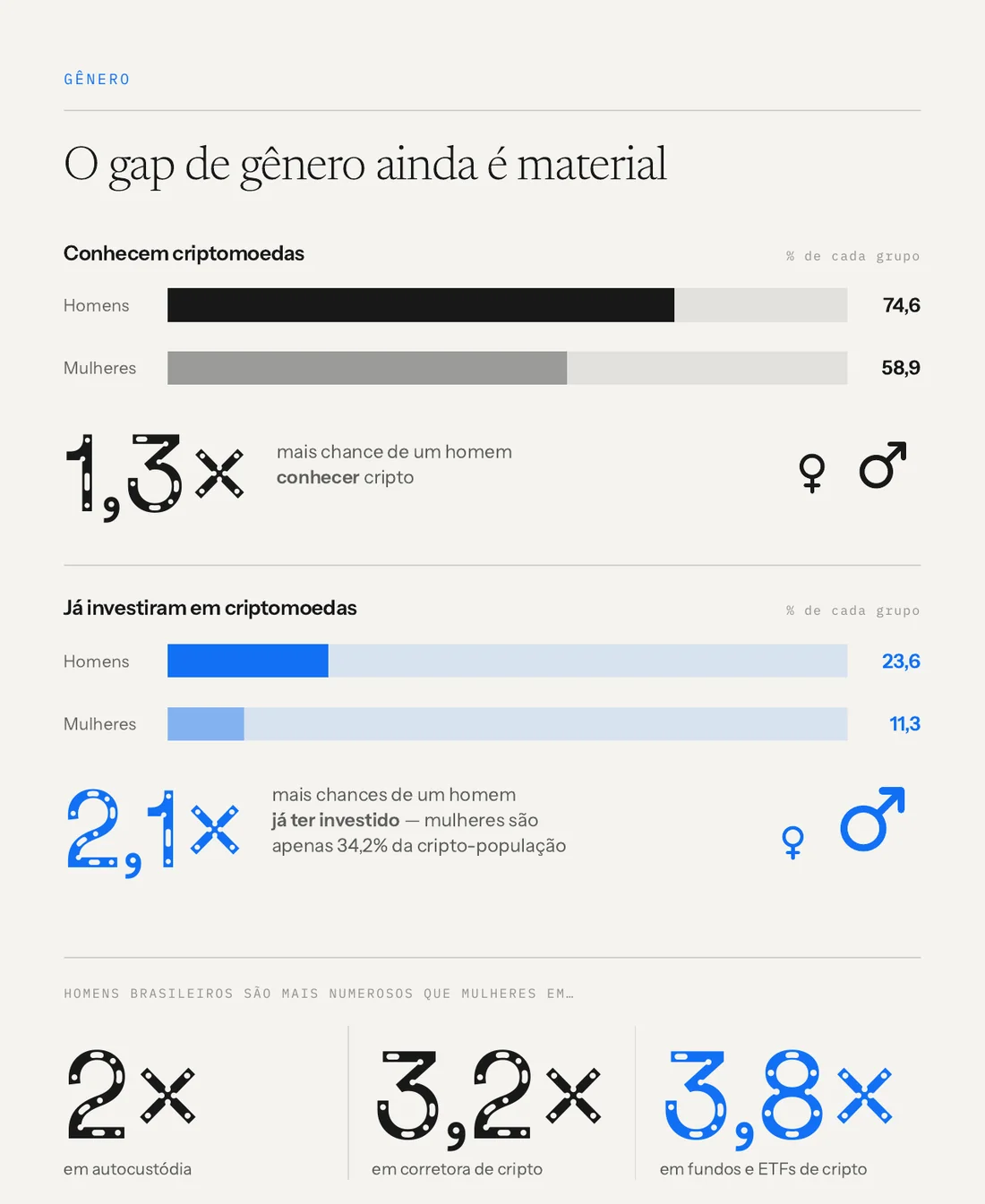
The gap between men and women is still large. 74.6% of men and 58.9% of women know about crypto. 23.6% of men and 11.3% of women have invested, and women make up only 34.2% of the crypto population. There are twice as many men in self-custody, 3.2 times as many on exchanges and 3.8 times as many in funds and ETFs.
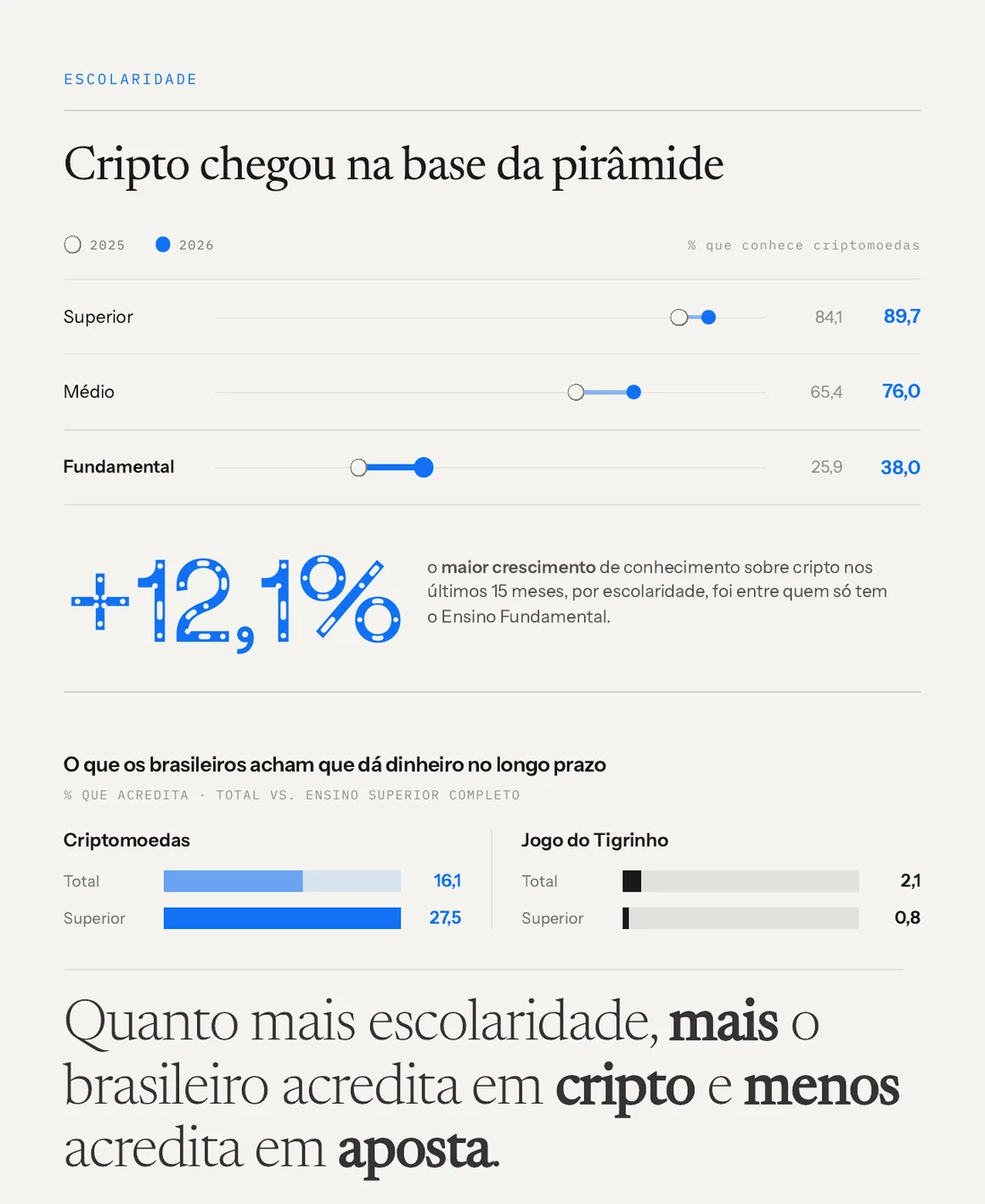
By education level, the news is that crypto has reached the base. The largest growth in awareness was among people with only primary education, from 25.9% to 38.0%. The survey also asked what makes money in the long run: 16.1% point to cryptocurrencies, rising to 27.5% among those with higher education. Jogo do Tigrinho, a popular online betting game, is cited by 2.1% overall and 0.8% among the most educated.
Interest, doubts and fears
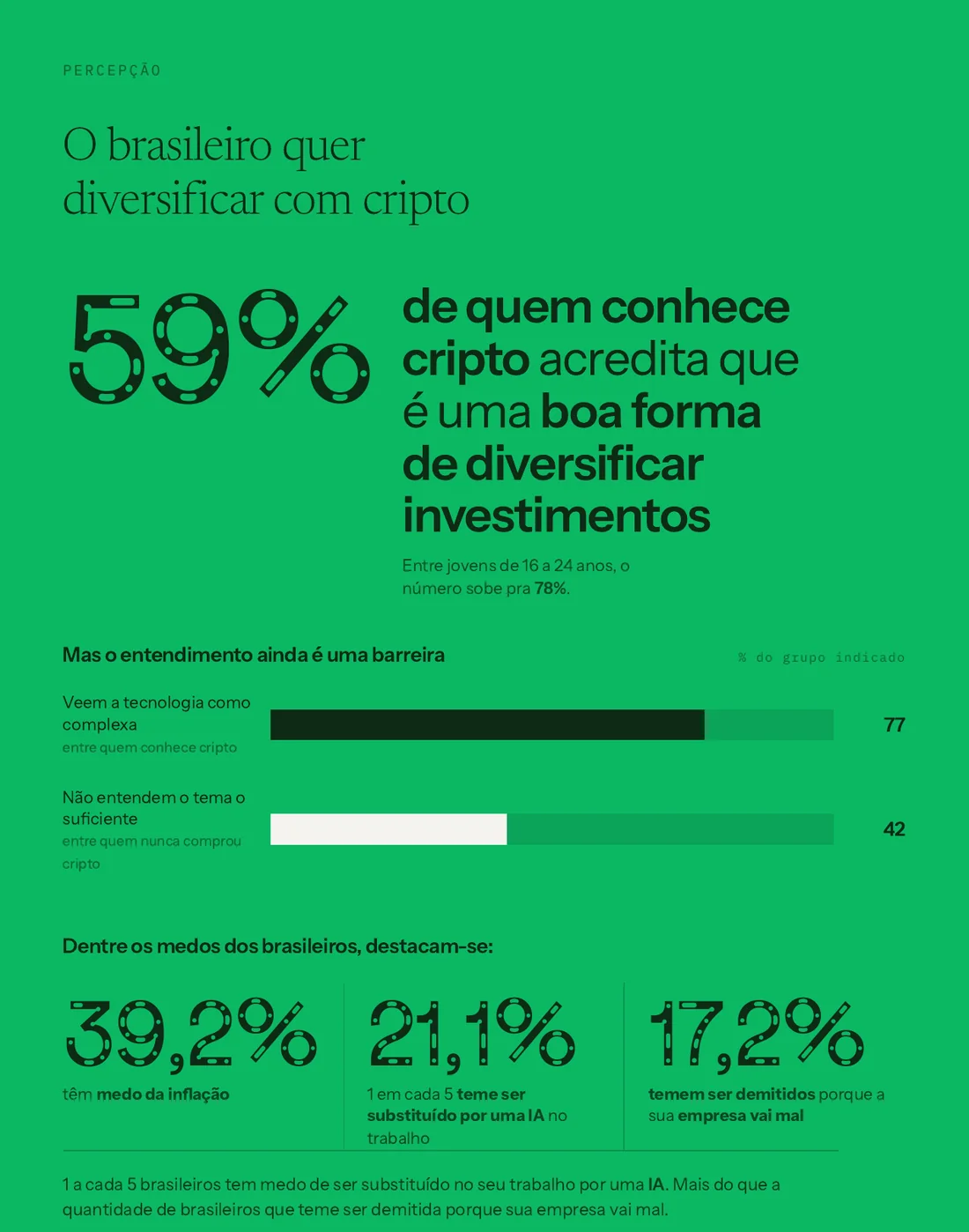
Among those who know about crypto, 59% see it as a good way to diversify investments, a figure that rises to 78% among young people aged 16 to 24. But understanding is still a barrier: 77% consider the technology complex, and 42% of those who have never bought say they do not understand it well enough.
The survey also recorded Brazilians' fears: 39.2% fear inflation, 21.1% fear being replaced by artificial intelligence at work and 17.2% fear being laid off because their company is doing badly.
Self-custody nearly doubled
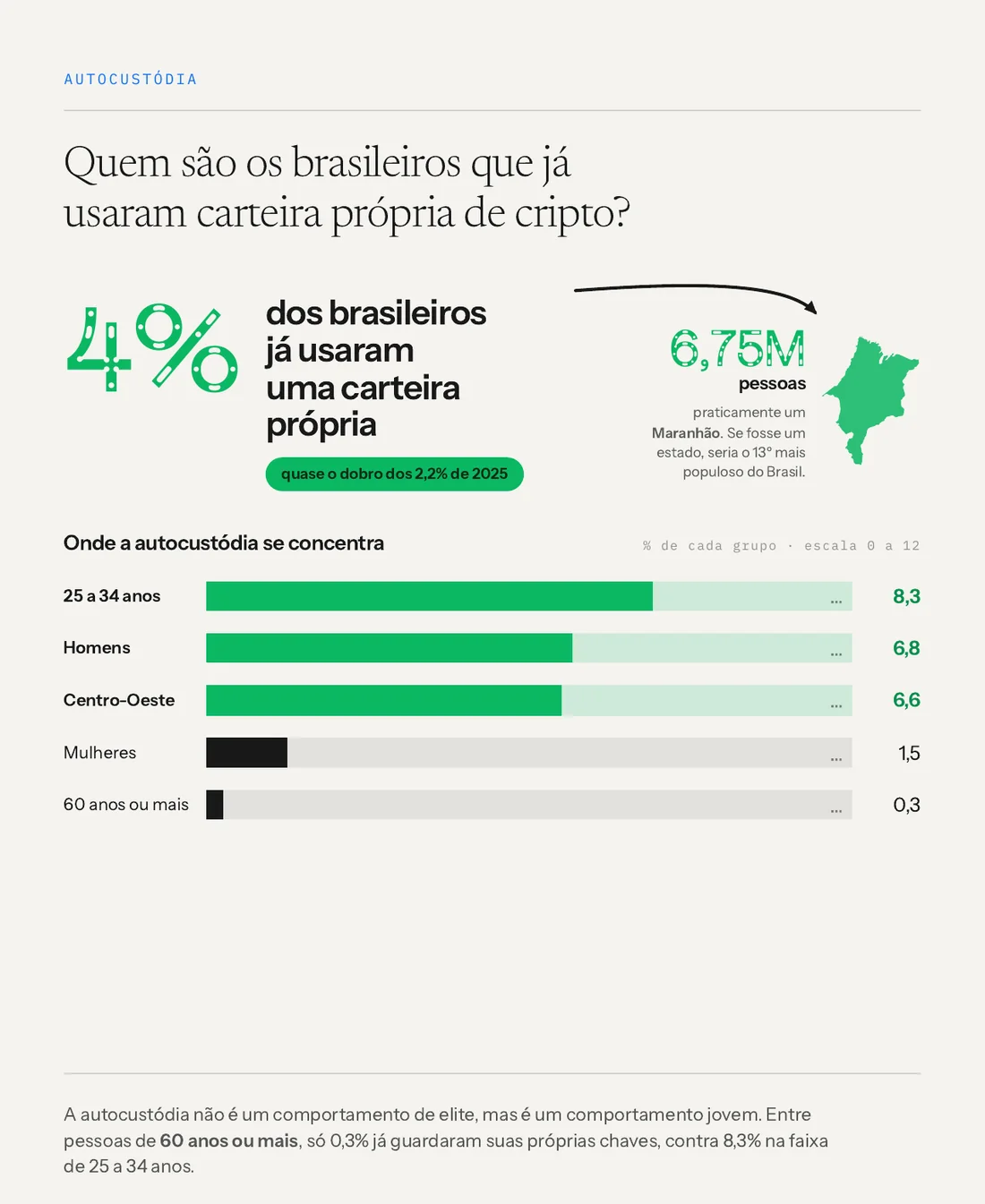
The share of Brazilians who have used their own crypto wallet rose from 2.2% in 2025 to 4%, about 6.75 million people. The practice is young: it reaches 8.3% among people aged 25 to 34 and just 0.3% among those 60 and over. It is also more common among men (6.8%) than women (1.5%).
The Center-West leads
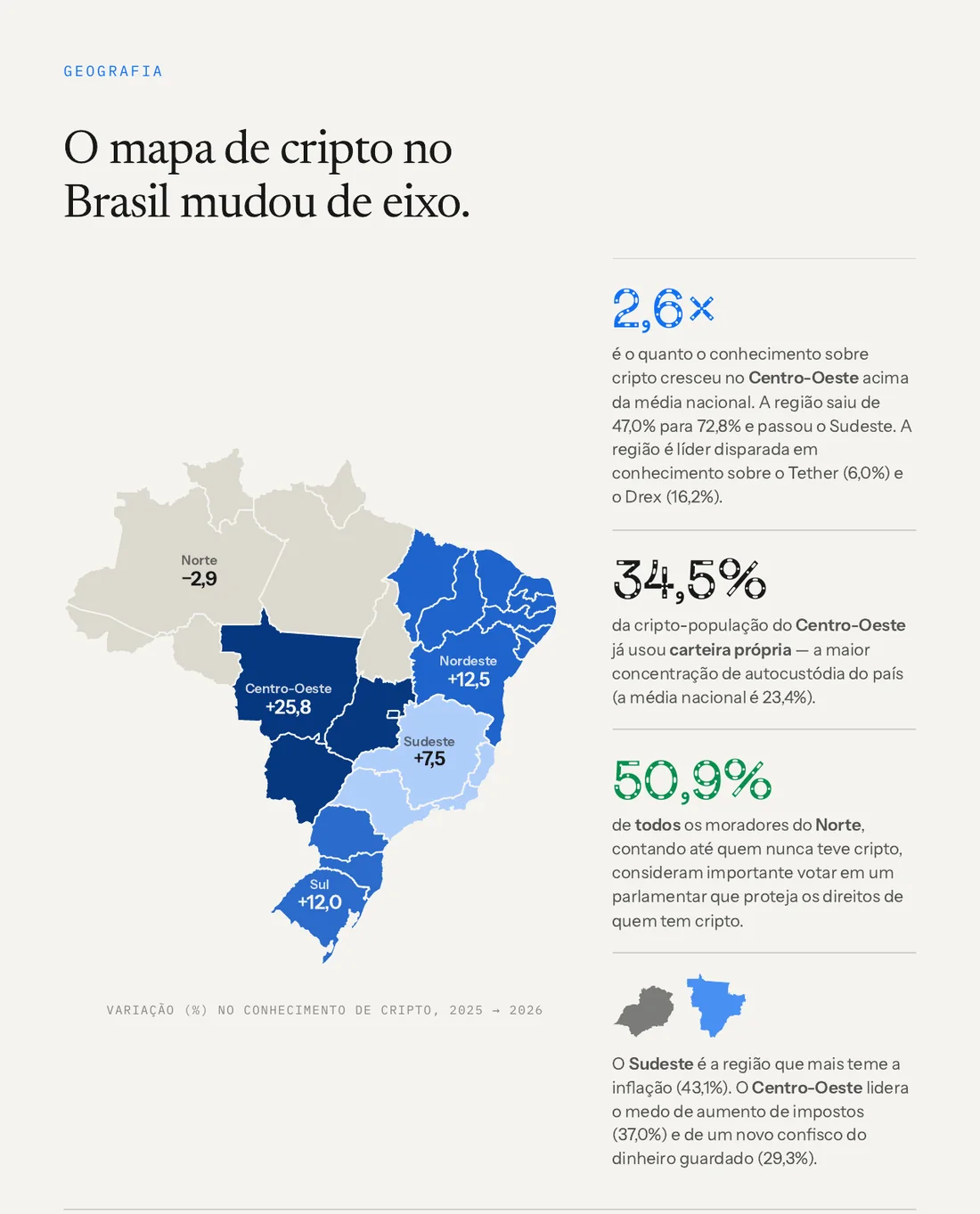
Brazil's crypto map has shifted. Awareness grew 25.8 points in the Center-West, from 47.0% to 72.8%, 2.6 times faster than the national average, and the region overtook the Southeast. In the North, it fell 2.9 points.
Why it matters
The data show that Brazil's crypto economy is already a mass phenomenon, popular and diverse, and not a niche of wealthy investors. That makes the debate on responsible regulation, financial education, consumer protection and reducing gender and access gaps all the more urgent.
It also shows that crypto has entered the electoral agenda. Ignoring the topic means leaving millions of Brazilians without anyone to talk to in the democratic camp.
All data and charts in this article come from the 2nd National Cryptocurrency Survey, carried out by Paradigma and Datafolha, sponsored by Coinbase and Hashdex and supported by ABcripto. The charts are reproduced in the original Portuguese. The full report is available in the references below.
References
- 01PARADIGMA; DATAFOLHA. Segunda Pesquisa Nacional das Criptomoedas. Patrocínio: Coinbase e Hashdex. Apoio: ABcripto. São Paulo, agosto de 2026.
- 02PARADIGMA; DATAFOLHA. Pesquisa Nacional das Criptomoedas (1ª edição). Campo de 9 a 11 de dezembro de 2024.
- 03IPSOS-IPEC. Pesquisa sobre torcidas de futebol no Brasil, 2025 (citada no relatório).